
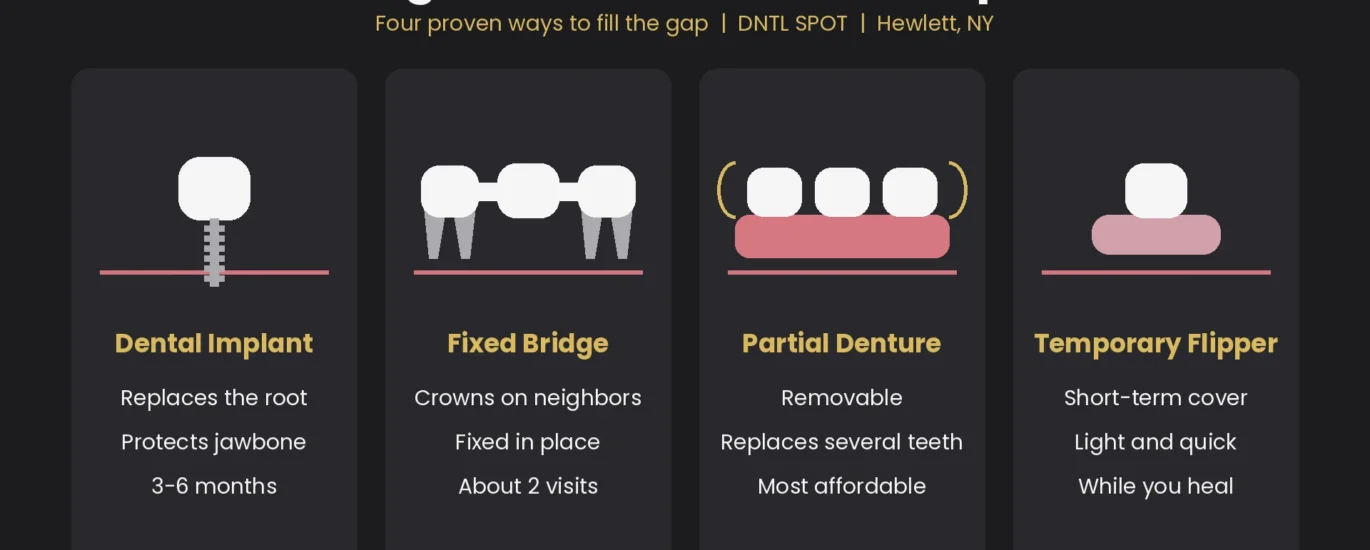
A missing tooth is more than a gap in your smile. Within months, the teeth next to the space start to drift, the tooth above or below it can over-erupt, and the jawbone where the root used to be begins to shrink. The good news: there are several proven missing tooth solutions in Hewlett, and the right one depends on your bite, your bone, your budget and how quickly you want the space filled. This guide compares the four main options side by side, so you can walk into your consultation knowing what to ask.
Why replacing a missing tooth matters
It is tempting to leave a missing tooth alone, especially if the gap is at the back where nobody sees it. But the space affects the rest of your mouth in ways you may not notice right away:
- Shifting teeth. Neighboring teeth tip into the gap, which opens spaces elsewhere and makes cleaning harder.
- Bone loss. Without a root to stimulate it, the jawbone under a missing tooth slowly resorbs. Waiting too long can make an implant harder to place later.
- Bite and chewing changes. You start chewing on one side, which puts extra load on the remaining teeth and the jaw joint.
- Appearance. A front gap is obvious, but even back teeth support your cheeks and lips. Several missing teeth can make the face look older.
None of this means you have to act tomorrow. It does mean the decision is worth making on purpose, with a dentist who will lay out every missing tooth option honestly.
Option 1: A dental implant
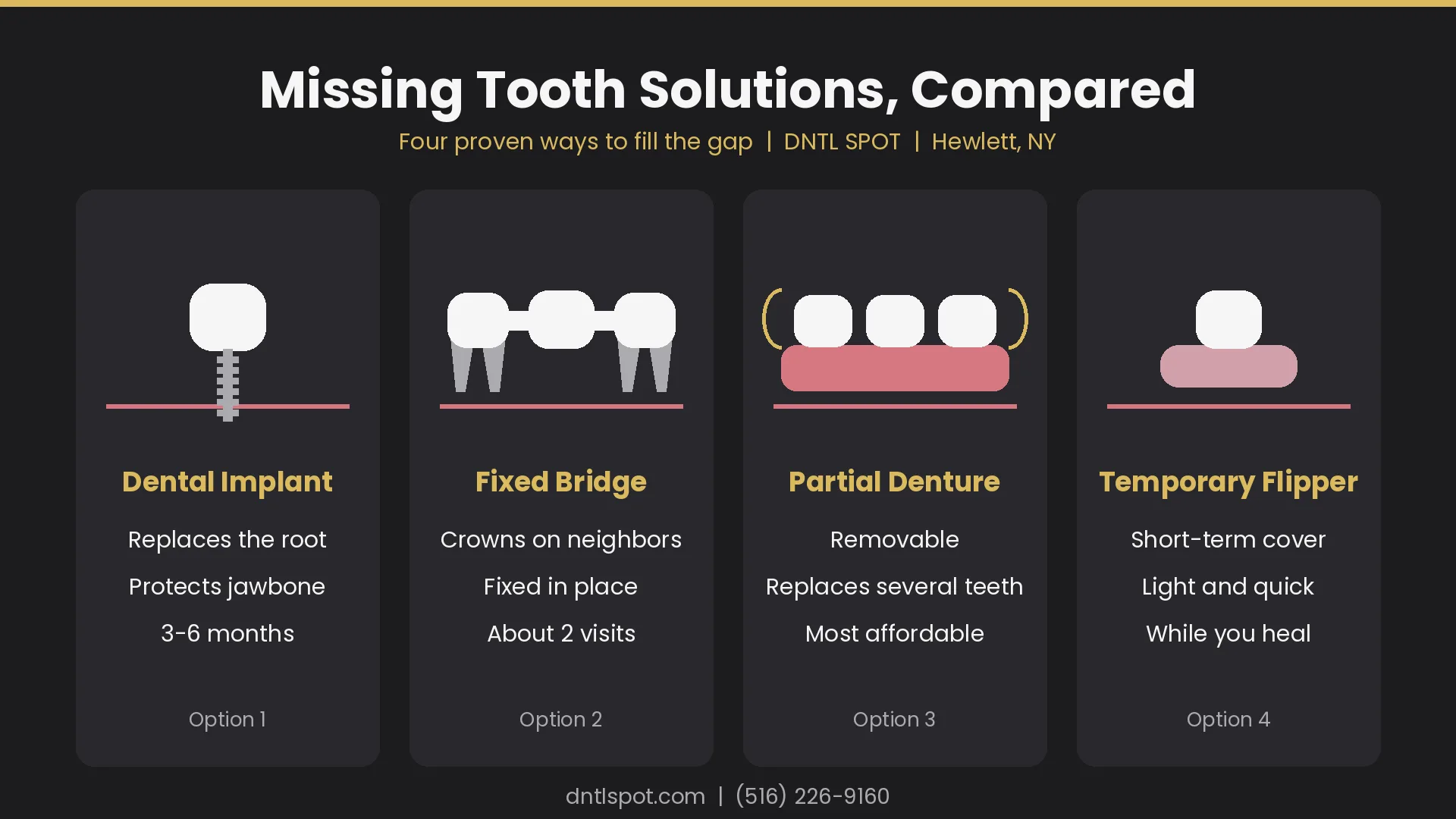
A dental implant replaces the tooth from the root up. A small titanium post is placed in the jawbone, the bone fuses to it over a few months, and then a custom crown is attached on top. It is the closest thing to getting your own tooth back, and it is the only missing tooth solution that also protects the bone underneath.
At DNTL SPOT, we handle the restorative half of implant treatment: the planning, the 3D digital scan, the abutment and the crown you actually see and chew with. A trusted oral surgeon places the implant post, and we coordinate the whole process so you are not left managing two offices.
- Best for: one or more missing teeth in a patient with healthy gums and enough bone.
- Timeline: usually three to six months from placement to final crown, because the bone needs time to heal.
- Pros: does not touch neighboring teeth, prevents bone loss, looks and feels natural, can last decades with good care.
- Cons: highest upfront cost, requires a minor surgery, and takes the longest to finish.
Option 2: A fixed dental bridge
A dental bridge fills the gap with a false tooth that is held in place by crowns on the teeth on either side. It is cemented in, so you never take it out, and it can usually be completed in two visits a few weeks apart.
- Best for: a missing tooth when the teeth on either side already have large fillings or crowns, or when an implant is not an option.
- Timeline: typically two visits, about two to three weeks apart.
- Pros: fast, fixed in place, natural-looking and usually covered in part by dental insurance.
- Cons: the neighboring teeth must be reshaped for crowns, flossing under the bridge takes a special threader, and it does not stop bone loss under the gap.
Bridges are a strong choice when the teeth next to the gap would benefit from crowns anyway. If those teeth are healthy and untouched, an implant often makes more sense, because it leaves them alone.
Option 3: A removable partial denture
A partial denture is a custom appliance with one or more replacement teeth attached to a gum-colored base. Small clasps hold it to your natural teeth, and you take it out to clean it and while you sleep. Our dentures page covers full and partial options in more detail.
- Best for: several missing teeth in the same arch, patients who want a lower-cost option, or as a step before implants.
- Timeline: a few visits over several weeks for impressions, a try-in and the final fit.
- Pros: the most affordable way to replace several teeth at once, no surgery, easy to add a tooth later.
- Cons: it feels bulkier than fixed options, the clasps can show, it needs daily removal and cleaning, and it does not prevent bone loss.
Option 4: A temporary flipper
A flipper is a lightweight, removable plastic tooth on a small base. It is not meant to be a long-term missing tooth solution, but it is a useful bridge while you heal from an extraction or wait for an implant to integrate. Nobody has to walk around with a visible gap during treatment.
- Best for: a front tooth while an implant heals, or short-term coverage after an extraction.
- Pros: quick to make, inexpensive, fills the space for appearance.
- Cons: fragile, not designed for heavy chewing, and only a temporary fix.
Missing tooth options compared
Here is how the four missing tooth solutions stack up on the questions patients ask us most:
- Feels most like a real tooth: implant, then bridge, then partial denture, then flipper.
- Protects the jawbone: implant only.
- Leaves neighboring teeth untouched: implant, partial denture and flipper. A bridge requires crowning the teeth on either side.
- Fastest to finish: flipper, then bridge, then partial denture, then implant.
- Lowest upfront cost: flipper, then partial denture, then bridge, then implant.
- Best long-term value: often an implant, because it does not need replacing as often and protects the teeth and bone around it.
How to choose the right missing tooth solution
There is no single best answer for everyone. These are the factors we weigh with you at your consultation:
- Where the gap is. A front tooth puts appearance first; a back molar puts chewing strength first.
- The health of the neighboring teeth. If they already need crowns, a bridge does double duty. If they are pristine, an implant protects them.
- Bone and gum health. We check bone levels on a 3D scan. Gum disease needs to be treated first, whatever you choose.
- Medical history. Uncontrolled diabetes, heavy smoking and some medications affect implant healing.
- Budget and insurance. We give you a written estimate for each option with your insurance applied, so you can compare real numbers.
The goal is not to sell you the most expensive option. It is to find the one you will be happy with ten years from now. If you are not sure where to start, a checkup and exam is the right first step.
What about the cost?
Cost depends on the option, the number of teeth and whether you need extra steps such as an extraction or bone grafting first. Many PPO plans cover part of a bridge or partial denture, and some cover part of the implant crown. We verify your benefits before treatment and walk you through the numbers in writing. No dental insurance? Our membership plan includes savings on restorative treatment, and you can see payment options on our insurance and financing page.
Replacing a missing tooth after an extraction
If you are about to have a tooth removed, plan the replacement now, not after. Sometimes the extraction and the implant planning can be coordinated so the site heals in the best shape for an implant. We discuss this at every tooth extraction consultation, and we can make a flipper so you never leave with a visible gap.
Missing tooth solutions in Hewlett: your first visit
Your consultation at DNTL SPOT takes about an hour. We start by listening to what bothers you most about the gap, then take a full exam and a 3D scan. You see your own X-rays and photos on screen, we walk through every option that fits your case, and you leave with a written plan and costs. Nothing starts until you say yes. The practice is owned and run by sisters Dr. Inessa and Dr. Regina Murdakhayeva, who both earned their DDS at NYU College of Dentistry and treat every patient themselves.
For general background on tooth replacement, the American Dental Association’s patient site, MouthHealthy, is a reliable place to read more.
Frequently asked questions
How long can I wait to replace a missing tooth?
There is no hard deadline, but bone starts to shrink within the first year after a tooth is lost, and neighboring teeth can begin to drift. If you are leaning toward an implant, sooner is usually better.
Does getting a dental implant hurt?
The area is fully numbed for placement, and most patients describe the next few days as sore rather than painful, similar to an extraction. Over-the-counter pain relief is usually enough.
Is a bridge or an implant better for one missing tooth?
If the teeth on either side are healthy, an implant is usually the better long-term choice because it leaves them untouched. If they already need crowns, a bridge can solve both problems at once.
Do you see patients from outside Hewlett?
Yes. Our office at 1455 Broadway serves the whole Five Towns, including Woodmere, Cedarhurst, Lawrence and Inwood, plus Lynbrook, Valley Stream and Oceanside.
The bottom line
Every missing tooth has a good solution. An implant is the most natural and protects your bone, a bridge is fast and fixed, a partial denture is the most affordable way to replace several teeth, and a flipper keeps you covered while you heal. The best choice is the one that fits your mouth, your health and your plans. Call (516) 226-9160 or book online, and we will show you which missing tooth options make sense for you.
(516) 226-9160 – Mon & Wed 9 AM-5 PM, Sun 9 AM-3 PM