
Reshape the teeth that show — designed, previewed and fitted at 1455 Broadway in Hewlett.
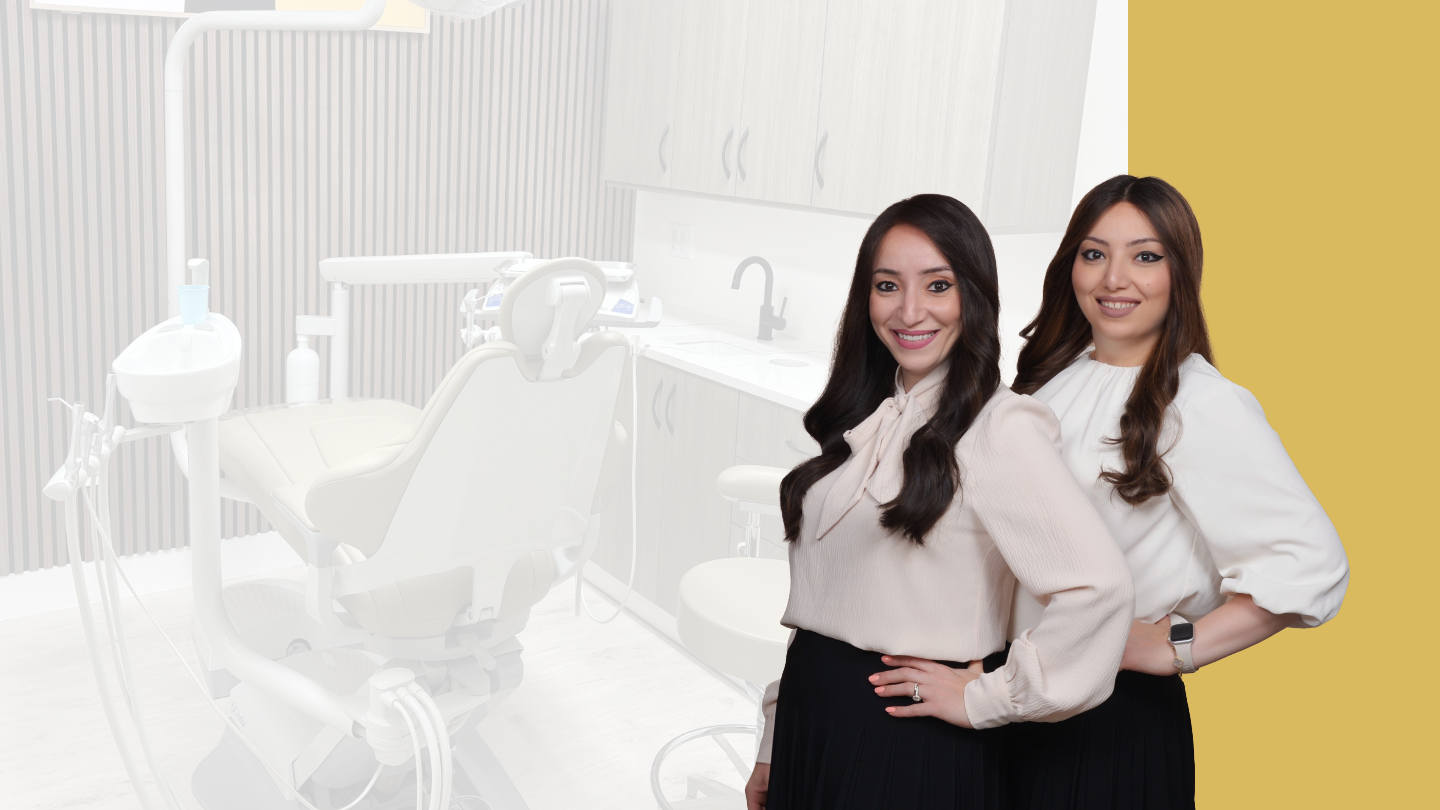
Dental veneers are thin shells bonded to the front of your teeth to change their shape, shade, or alignment. At DNTL SPOT in Hewlett, NY, Dr. Inessa Murdakhayeva and Dr. Regina Murdakhayeva design every case digitally and show you a preview before a single tooth is touched — because on front teeth, agreeing the result in advance is most of the work.
Thinking about it? The consultation costs you nothing but an hour and you will leave knowing whether dental veneers suit your teeth. Call (516) 226-9160.
On this page
We design and preview the result with you before a single tooth is touched.
An itemized estimate with your insurance applied, before treatment starts.
Dr. Inessa and Dr. Regina treat you themselves, start to finish.
A dental veneer covers the visible front surface of a tooth, roughly the way a false fingernail covers a nail. Porcelain dental veneers are typically between 0.3 and 0.7 millimeters thick — about the thickness of a contact lens — and they are bonded with an adhesive that, once cured, makes the veneer and the tooth behave as one structure.
That bond is the whole trick. Ceramic on its own is brittle; bonded to enamel it becomes remarkably strong, which is why enamel preservation matters so much and why a dental veneer on a tooth with little enamel left is a different, weaker proposition. The American Dental Association has a short overview if you want to read around the subject.
Most cases involve between six and ten upper teeth, because that is what shows in a wide smile. Treating a single tooth is possible and is the hardest shade match in dentistry, since it has to disappear next to its neighbors.
They work well for:
They are the wrong tool for significantly crooked teeth, where Invisalign first gives a far better and more conservative result; for a tooth that has lost a lot of structure, which needs a crown; for active decay or gum disease, which have to be treated first; and for heavy untreated grinding, which will break them.
If dental veneers are not right for your teeth, we will tell you at the consultation. Starting a case that was never going to work is the most expensive mistake in cosmetic dentistry.
Not sure veneers are the right fix?
Sometimes whitening or bonding gets you there for far less. We will tell you which.
Porcelain. Made in a laboratory from your digital design and bonded at a second visit. They resist staining almost completely, reproduce the translucency of enamel, and commonly last ten to fifteen years or more. This is what most people mean by dental veneers and it is what we recommend for a full smile case.
Composite. Built directly onto the tooth in one appointment using the same resin used for tooth-colored fillings. Cheaper, quicker, repairable, and usually requiring almost no tooth removal. The trade-offs are real: composite stains over time, does not hold a polish as long, and lasts perhaps four to seven years. For one chipped tooth, or for a patient who wants to try the shape before committing, it is an excellent option.
No-prep and minimal-prep. Ultra-thin porcelain bonded with little or no enamel reduction. Genuinely reversible, which is their great advantage. They only work where the teeth are already small or set back — adding thickness to teeth that already sit forward makes them look bulky, and no laboratory can get around that. We will tell you honestly whether your teeth are candidates rather than promising no-prep and then quietly preparing them anyway.
Work from least invasive upward, which is the order we discuss them in.
Whitening changes color only, removes no tooth structure, and costs a fraction as much. If shade is your only complaint, start here.
Bonding repairs a chip or closes a small gap in one visit, with minimal preparation. Ideal for one or two teeth.
Invisalign moves teeth into the right position while keeping all of your enamel. Where crowding or rotation is the real issue, aligners first often mean fewer or no veneers afterwards — and where veneers are still wanted, straightening first means far less tooth has to be removed.
Dental veneers change color, shape, and apparent position at once, which is why they are so effective and why they are also the biggest commitment. On a prepared tooth, the change is permanent: that tooth will need a veneer or a crown for the rest of your life.
We examine your teeth and gums, take photographs and a digital scan, and talk about what specifically bothers you. Vague goals produce vague results, so we push for specifics — length, shade, whether you want visible character or a uniform look.
A digital design shows the proposed result. Where it helps, we make a temporary mock-up directly over your unprepared teeth so you can see the shape in your own mouth, in a mirror, in daylight, before consenting to anything. This is the single most valuable appointment in the sequence.
Under local anesthetic, a thin layer of enamel is removed — usually around half a millimeter — guided by the approved design rather than done freehand. Preparing to the design is what keeps the reduction minimal.
You wear temporary dental veneers while the laboratory works. Live with them for two weeks and tell us what you would change; those notes go to the technician.
The finished dental veneers are tried in with water or try-in paste first, so you see them in place before they are permanent. Once you approve, each one is bonded and cured, the bite is checked, and the margins are polished.
We see you a couple of weeks later to check the gums have settled and the bite feels right, and again at your regular recalls.
Allow around three to four weeks from consultation to bonding for a porcelain case.
Want to see the result first?
We design and preview your smile before any tooth is prepared.
The difference between a case people notice and a case people cannot identify comes down to a handful of details, none of which are about the porcelain itself.
Proportion. Natural upper central incisors are roughly four units wide to five units long. Teeth made too square look blocky; too long and they look like a costume. We set proportion against your face and lip line rather than to a formula.
The smile line. The edges of the upper front teeth should follow the curve of the lower lip. Dental veneers made to a flat line across all six teeth are the most common giveaway of cheap work.
Variation. Real teeth are not identical. The laterals sit slightly shorter than the centrals, the canines have a subtly different character, and edges are not perfectly uniform. Building that in is what stops a case reading as manufactured.
Translucency at the edge. Natural enamel becomes more translucent toward the biting edge, picking up a faint gray or blue. Flat opaque white across the whole tooth is what makes dental veneers look like plastic.
Gum symmetry. If the gum sits noticeably higher on one tooth, that asymmetry will be obvious no matter how good the porcelain is. Minor recontouring beforehand can be the difference between good and excellent, and we will raise it if it applies.
Dental veneers are priced per tooth, so the total depends on how many you have. Porcelain costs more than composite. A case that needs whitening of the lower teeth first, or gum recontouring to even up the smile line, carries those as separate items.
On insurance, be prepared for a straight answer: dental veneers placed purely to improve appearance are almost never covered. Dental plans exclude cosmetic treatment. Where a dental veneer restores a tooth broken by trauma or repairs genuine structural damage, there is sometimes partial coverage, and we will submit a pre-treatment estimate to find out rather than assume. We are in network with fourteen PPOs — Aetna, AlwaysCare, Ameritas, Anthem, Cigna, Delta Dental, GEHA, Guardian, Humana, Lincoln Financial, MetLife, Principal, United Concordia, and United Healthcare — and we do not participate in Medicaid or Medicare.
Because this is usually self-funded, we give you a full written quotation before treatment and we do not add items later. Monthly financing is available — see our financial information page — and our membership plan discounts treatment for uninsured patients.


Want the price in writing?
An itemized estimate per tooth, with 0% financing for up to two years.
Cosmetic dentistry is marketed enthusiastically, so here is the other side of the ledger.
Prepared dental veneers are not reversible. Once enamel is removed, that tooth needs a veneer or a crown permanently. This is the single most important sentence on the page.
They will need replacing eventually. Ten to fifteen years is a reasonable expectation for porcelain. Budget for a second round in your lifetime.
Sensitivity is common for a few weeks after preparation and usually settles.
Porcelain does not change color, ever. That is mostly good, but it means your natural lower teeth will drift away from the shade over the years. Whiten those first, and expect to maintain them.
One veneer can chip. Porcelain usually cannot be repaired invisibly, so a fracture generally means remaking that tooth.
None of this argues against treatment. It argues for going in with accurate expectations, which is also what makes people happy with the result afterwards.
DNTL SPOT is owned and run by two sisters, Dr. Inessa Murdakhayeva and Dr. Regina Murdakhayeva. The dentist who designs your case is the dentist who prepares and bonds it.
Ready to talk it through?
Pick a time online in under a minute, or call and speak to the front desk.
We are at 1455 Broadway in Hewlett. Patients come to us for dental veneers and smile design from Cedarhurst, Lawrence, Inwood, North Woodmere, Lynbrook, Far Rockaway, East Rockaway, Atlantic Beach, and Valley Stream.
Dental veneer treatment runs over a few appointments, and the Sunday hours make those easier to fit around work. New to the practice? Our new patient resources page explains what to bring to a first visit.
Ready when you are
Come and see what is realistic for your teeth. You will leave the consultation knowing whether dental veneers suit your case, what the alternatives would achieve, and exactly what it costs. Check available times online or call the office.
1455 Broadway, Hewlett, NY 11557
(516) 226-9160
Monday & Wednesday 9:00 AM–5:00 PM · Sunday 9:00 AM–3:00 PM
Share a few details and we’ll show you our next available times.
Prefer to talk it through? Call us at (516) 226-9160